Key Takeaways On Tracing Meditation
- Tracing meditation is the practice of mindfully tracing images, combining traditional artistic and spiritual practices with modern research. The goal is to focus on the motion of your hand and the point where your finger or stylus is at any moment.
- Tracing meditation is well-suited for those who find traditional seated meditation difficult. As an active practice, it provides a clear and specific focus for your attention, making it easier to quiet your internal monologue.
- You do not need to be "artistic" to benefit from tracing meditation; the emphasis is on the experience rather than the final product. It also requires minimal space and mobility, making it more accessible than practices like yoga or walking meditations.
- The practice is inspired by several areas of research, including the use of calligraphy for stress reduction, the benefits of mindful movement, the therapeutic use of creative arts, and the modern understanding of the mind-body connection.
- Anyone can begin with just two to five minutes, a guide image on paper, or a touchscreen device with the Ibiss app.
Introduction
It is, one hears, the AI revolution, and this is the time for optimizing everything: business outcomes, one’s personal life, even—perhaps even especially—one’s health. Against the backdrop of an unprecedented mental health crisis, meditation has been held up as anodyne to the frenetic pace of the AI age. Perhaps even better suited to our age of wisdom and foolishness than the traditional seated meditation practices, though, is tracing meditation.
We’ve all heard about the benefits of meditation: lower stress, reduced cortisol, increased performance, better relationships. What’s not to like? Other than the voices in your head saying “why are you sitting here doing nothing?!? Stop wasting time!” and “you’re doing this wrong, why do you have so many thoughts? The point is to not think.” Oh yeah, and the instructions that won’t make sense until you’ve been practicing meditation for years (it turns out that after five years of daily seated meditation, “focus on your breath without tension” might suddenly start to makes sense, but it sure didn’t make sense to me for the first five years). Knowing that this is a shared experience, and that “monkey mind” is a part of the human condition is little consolation when your internal monologue will not shut up. Moreover, that persistent voice can make even an established practice feel stale.
Recent research on the mind-body relationship shows that there really is something to meditation, but getting started with what most of us picture when we hear “meditation” is hard, and sticking with it may be even harder. Many people have hobbies that offer some of the same benefits as mindfulness meditation, but without the experience of other mindfulness practices, they may not even realize that what they are doing is “meditating,” and not everyone can pick up a clarinet, paintbrush, or knitting needles and naturally achieve the sense of “effortless” one-pointed attention that many mindfulness traditions emphasize.
What is tracing meditation, anyway?
At its core, tracing meditation is simply the practice of tracing images mindfully. Everything else is window dressing. When you were learning to sign your name as a child, 100% focused on tracing a tricky letterform or completing a tricky connect-the-dots drawing, that was a tracing meditation in all but name.
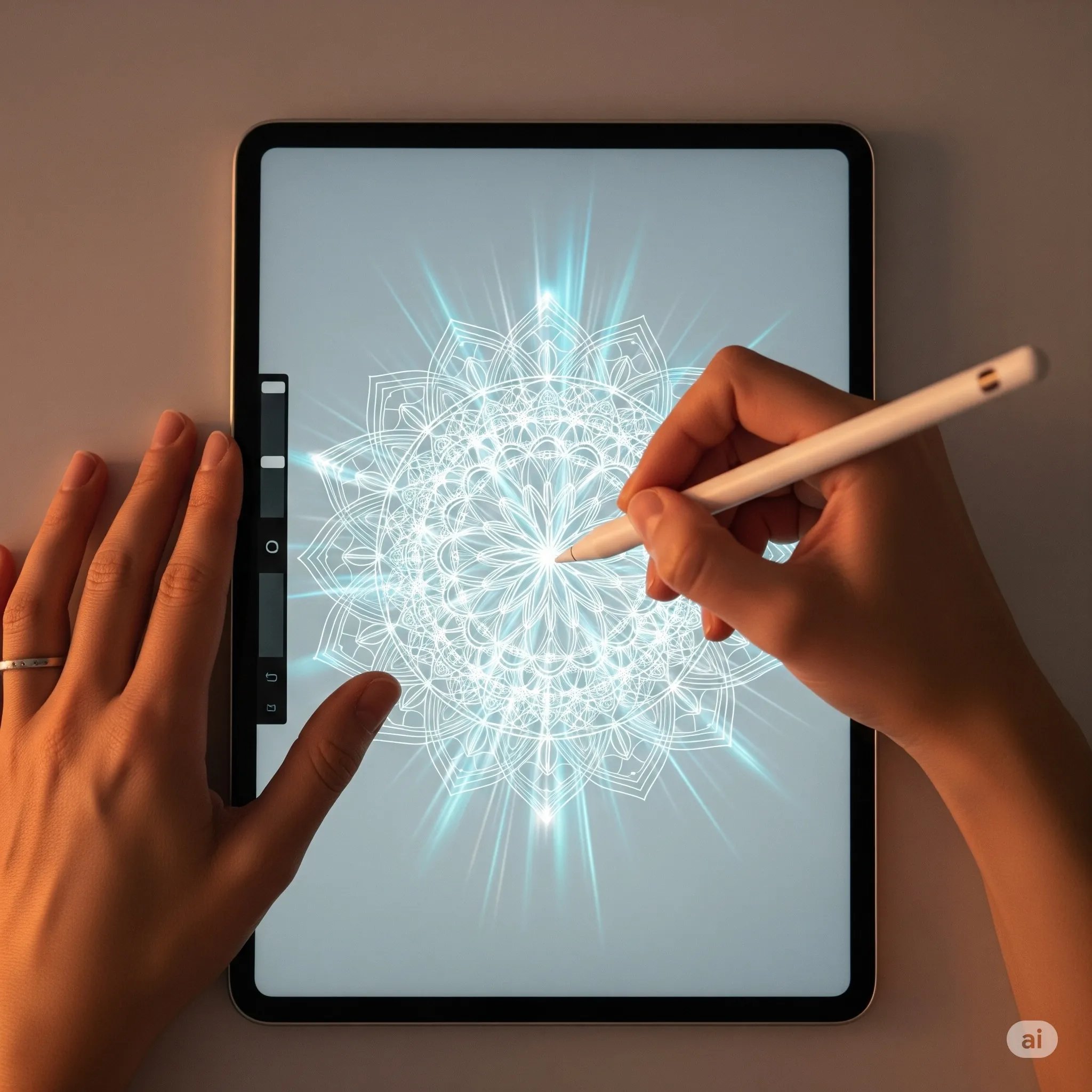
Tracing meditation is a modern approach to mindfulness that combines traditional artistic and spiritual traditions with recent research. Instead of sitting with your eyes closed or staring at a candle, you trace images that speak to you, focusing on the motion of your hand and where the stylus (or finger) is at any given moment. By keeping your focus on the act of tracing, tracing meditation helps you ignore the voice in your head that says “you’re doing this wrong” or “the laundry needs folding” or “did I remember to send that email to Greg?”
Rather than just tracing anything, you can optimize your tracing meditation (we’re still in the age of AI, after all!) by selecting as guides images that independently promote a mindful mental state. Images of nature, for example, have been shown to promote wellbeing, as have mandalas and other, similar forms. What resonates best, however, is deeply personal to each individual and an image that resonates with me may stress you out or vice versa.
Why tracing?
There are many activities that can promote mindfulness. In fact, pretty much anything can be done mindfully, with one clinically validated mindfulness program (MBSR) introducing the concept of mindfulness by having participants focus on eating two raisins. Tracing, however, offers particular benefits that other activities might not.
- First, as an active practice, tracing makes it easier to quiet your internal monologue (if you have one) and gives you a clear and specific focus for your attention. The tip of your pen (or finger) is a concrete and easily identifiable object to observe, unlike (for example) your breath, or (as I tend to use) the sensation of being grounded.
- Second, tracing is an activity that emphasizes the experience rather than the objective: since you are following a preexisting guide, you need not focus on what the final product will look like, nor where the next line will go, just on where your pen is at any given moment.
- Third, unlike many other forms of art, tracing does not require a person to be “artistic.” Even if your hand is unsteady or problematic depth perception confuses your proprioception, the guides make the process easier, and, of course, there is no grade in meditation: accuracy is irrelevant and your drawing can be ephemeral.
- Finally, unlike many types of mindful movement (yoga, walking meditations) tracing requires a minimal amount of space and mobility. On an airplane? No problem, there’s space to trace. Injured or otherwise limited in your mobility? Also not a problem, you can even use your non dominant hand. Yoga? A lot harder to do on an airplane or in a cast.
Who can benefit from tracing? (Hint: everyone)
Although there is limited research on tracing meditation specifically, research on related areas has shown benefits across a wide swathe of the population, from children in Argentina to college students in California to elders in Hong Kong.
Not only can almost anyone take up tracing meditation, getting started is easy: all you need is five minutes (or two minutes!) and either pen and paper with a guide printed on it or Ibiss and a touchscreen device (such as a tablet) or a phone. Depending on your goals, you might choose to do a fifteen minute tracing meditation first thing in the morning to start your day off right (most research studies have recommended 10+ minutes for this sort of mindful activity), a five minute tracing meditation as a reset between stressful meetings, or a two minute tracing meditation as a way of setting your intention as you prepare for a challenging creative task.
Using Ibiss for a tracing meditation
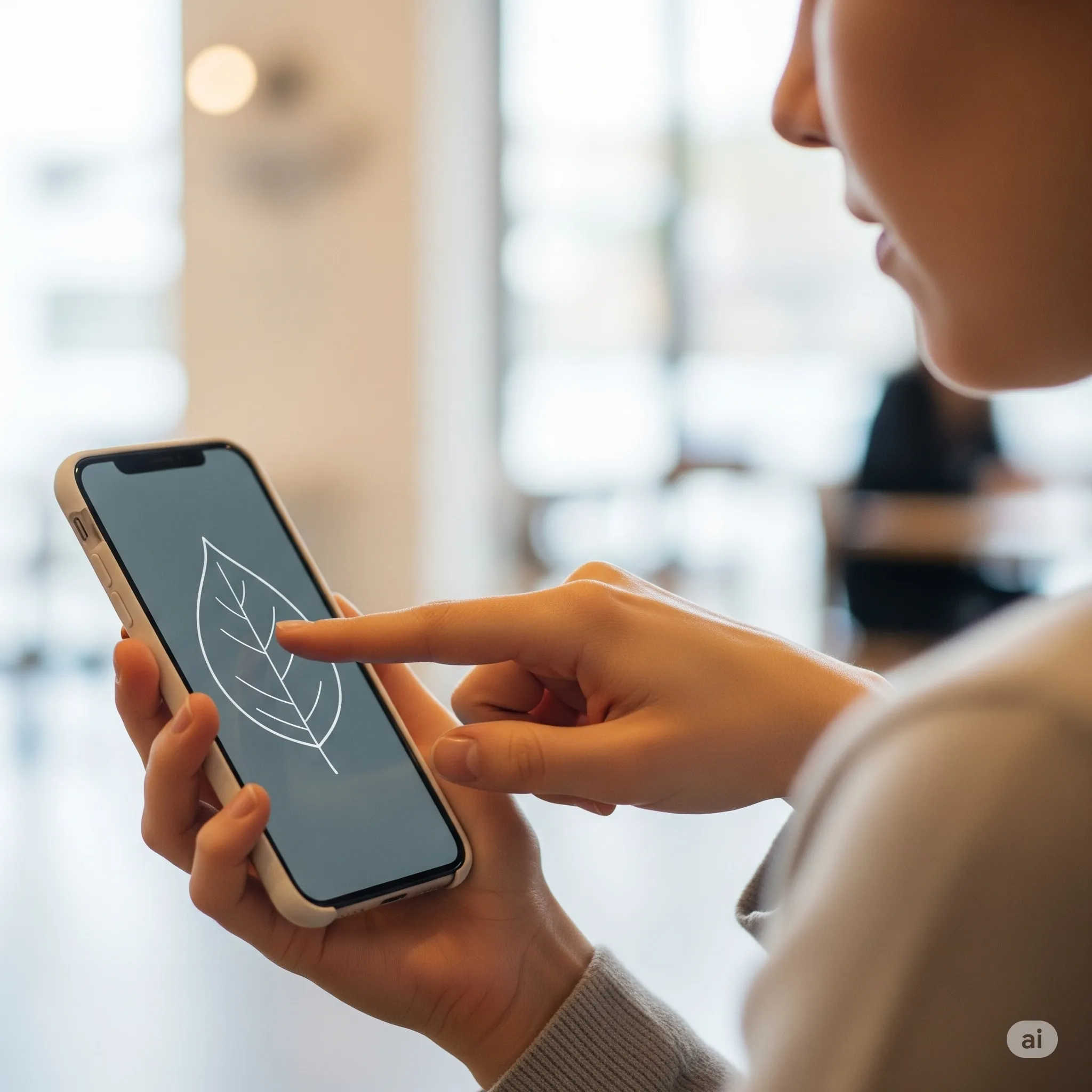
Starting a tracing meditation with Ibiss is easy: choose one or more images that you want to trace (or just choose to do an Instant Meditation and we’ll choose images for you), choose the length of your meditation, and optionally choose a soundtrack. Then (unless you chose an Instant Meditation, in which case you are already ready to go!) choose the arrow in the art tray at the bottom of the screen to continue on to the tracing meditation itself. On the meditation screen, you use either your stylus or finger to trace the image you are presented with. Once you have completed an image, tap the arrow in the top right to get a new image to trace. You can customize your mediation session with different implements from world calligraphic traditions as well as changing colors and soundtracks both in the menu accessed from the top left during a meditation and before you begin the tracing meditation on the same screen where you selected images to trace. At the end of your meditation, you will be able to see the details of your tracing session and how your emotional state changed—as represented by the images you created—throughout the session. If you found your mind getting less calm instead of more calm as the session progressed, that’s fine: as you practice observing what you are doing, you may find yourself more aware of how you are feeling, including, perhaps, more tense.
Although there is no such thing as a bad choice of image to trace, different images may speak to you more or less on a given day. Recognize that this is normal, and don’t be afraid to use a different image (or even subscribe and select your own favorite images from anywhere). On the other hand, if you find yourself tracing the same image over and over, this isn’t a bad sign either. In fact, it is an opportunity to practice even deeper mindfulness, approaching the image each time with what a Buddhist might call “beginner’s mind,” letting go of your previous attachments to the image each time you encounter it, letting yourself be guided exclusively by the lines you see in front of you and the feeling of the stylus on the screen.
The science behind the lines
Tracing meditation draws on a variety of research corpora. The key areas of research that inspired it, though, are:
- The use of calligraphy for both stress reduction and preventing cognitive decline
- Active meditations in contemplative traditions
- Recent developments in the understanding of the close relationship between the mind and body
Approaches to nurturing creativity and the use of creative art as a therapeutic modality
Writing wellness
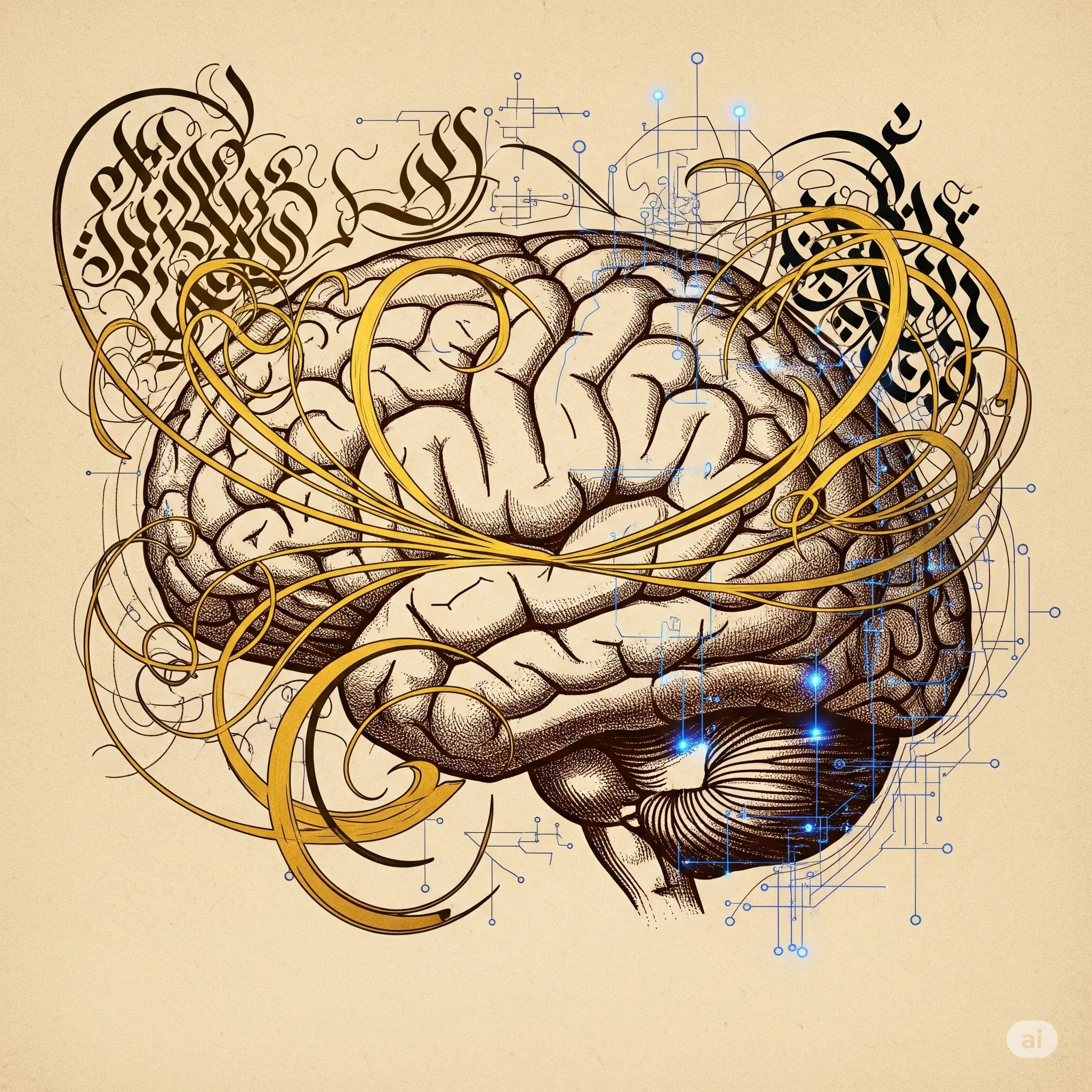
The world’s many calligraphic traditions have produced many works that cross the line from mere written communication (not that there is anything “mere” about our ability to look at lines on a page and understand what is happening in the mind of the unknown person whose thoughts are encoded in those lines!) to beautiful works of both literary works of art. Consider, for example, the illuminated Book of Kells at Trinity College Dublin, or the thuluth script in the Iznik tile work of the famous blue mosque in Istanbul, or John Hancock’s famous signature on the Declaration of Independence. Calligraphy is more than just a lovely way to share ideas, though.
Chinese calligraphic handwriting has been tested by researchers as far-flung as Hong Kong, Beijing, and California, finding it an effective intervention for helping college students handle anxiety and older individuals stave off cognitive decline. In a randomized controlled trial conducted in Anatolia, Turkey, researchers found that three weeks of 60-minute calligraphy sessions had a measurable impact on trait anxiety and depression, concluding that calligraphy showed promise as a form of treatment for common mental illness. Taking up calligraphy, however, can be daunting, and is generally best done with a teacher who can help you. In contrast, tracing requires no training and makes intuitive sense to most people.
A brief, incomplete history of mindful movement
Dating back thousands of years, two of the best known forms of mindful movement today are yoga and traditional East Asian martial arts. Both emphasize the use of mindful movements as a form of discipline and self-mastery, and in recent decades both have increasingly been used as adjuncts or even alternatives to other forms of mental health care, with extensive bodies of literature showing their effectiveness at improving both subjective wellbeing and various health markers. Strongly influenced by various religious traditions (Hinduism, Buddhism, and Shintoism, for example), these millennia-old practices have exploded in popularity since the 1960s, bringing widespread acceptance of the idea of mindful movement as a component of health and wellbeing.
While those may be the best known, other traditions, too, include mindful movements. Throughout the history of Christianity, there have been a number of contemplative movements that emphasize active forms of contemplation. Perhaps the best known form of mindful movement in Christianity is labyrinth walking, which takes as its basis the labyrinth, a pattern which dates back at least to antiquity and became widely used as a contemplative tool in Medieval Christianity.
By providing a concrete focus, mindful movement solves some of the challenges associated with seated meditation, helping practitioners to focus on their bodies and dismiss the fleeting distractions of the monkey mind. Most, however, require both space (hard to do a walking meditation, much less walk a labyrinth, in a New York apartment!) and a level of physical capability that may not be available to everyone. Tracing, on the other hand, is far more accessible both in terms of space requirements and in terms of physical abilities needed.
Body and mind to the embodied mind
Why does mindful movement work, though? Since Descartes said “I think therefore I am,” Western culture has mostly accepted the theory that the mind and the body are two distinct concepts with at most a tenuous interface. Recent research, however, has thrown serious doubt onto this view. Emotional trauma, for example, seems increasingly to have a physiological correlate, and can be treated through modalities such as somatic therapy or EMDR (Eye Movement Desensitization and Reprocessing) that integrate both mental and physical aspects into a single holistic treatment.
This alternative understanding of the relationship between mind and body echoes that of numerous healing traditions such as Ayurveda and Traditional Chinese Medicine, traditions that have enjoyed a resurgence of interest with the backlash against modern allopathic medicine and the side effects that come with many medications. By nurturing the connection between mind and body, some individuals may find that mindful activities such as tracing meditations are sufficient by themselves to address the stresses of the modern world.
Art and anxiety
The final, and perhaps most impactful, source of inspiration for tracing meditation is the creative arts, and its use as a tool for both wellness and treating mental disorders such as depression and anxiety. As a form of psychotherapy, art therapy emerged around the middle of the last century, and has been shown to be effective in a variety of settings, including cancer wards, child psychology, and inpatient behavioral health facilities. In particular, research on such art forms such as coloring, drawing mandalas, and tracing labyrinths have been shown to be effective interventions for various endpoints, including reduced trait anxiety, lowered cortisol, and even improved social interactions.
Parallel to art therapy as a part of sick care, art as a source of self-actualization and personal growth has also received extensive attention, with numerous programs—some more compelling than others—addressing the question of how to manage ones’ life for creativity and wellbeing. For people like me who do not, in fact, possess all that much visual creative ability (designing a website? Maybe. Painting a happy little tree? Not very likely!), tracing is perhaps the perfect balance: we can enjoy the experience of creating a work of visual art without beating ourselves up over the fact that our “happy little accidents” do not bring any joy to our painting.
Your first tracing meditation, step by step
- Sign up for Ibiss
- Choose “Instant Meditation”
- Read the instructions
- Use your stylus (or your finger) to slowly trace the lines of the first image you are presented with, directing all your focus at where your stylus (or finger) is; if you make a mistake, don’t worry, just keep going
- When you have finished tracing the image (whether because you have traced all the lines or because you feel ready to move on), tap the arrow in the top right
- Trace the next image, repeating steps 4–5 until you reach the end of your time
- If you like, browse through your tracings; can you see a progression as your mind calmed… or got less calm
- Come back tomorrow for another tracing meditation
The story of Ibiss
Ibiss grew out of a calligraphy-friendly canvas component for another product that was too much fun to use not to create a small app centered around it to play with while working on the other project. There was only one problem… while the canvas was very rewarding to draw on, the drawings were… very reflective of my visual art skills. Which is to say, not what was in my mind when I put pen to paper (well, stylus to screen). So I started using it for tracing and found the experience surprisingly similar to my daily meditations, but perhaps a bit less frustrating. Thus was the idea for Ibiss born (well, with the help of reasonably extensive prior reading on mindfulness, calligraphy, and art therapy).
Since the first feature was a canvas that could switch between fountain pen, qalam, and (especially) quill, a bird felt like the natural symbol for the project. As for which bird? Well, there could really be only one choice: the ibis has been associated with writing for time immemorial. Or at least since ancient Egypt, where the ibis-headed Thoth used a reed pen when he invented writing. As for the double S, well, it just makes the word more interesting, and offers the opportunity to use a Scharfes S. And really, who doesn’t want to use a Scharfes S?
Ready to find your focus?
We all know mindfulness is good for us, but finding a mindfulness routine is difficult. Tracing meditation offers a promising new evidence-based approach accessible to almost anyone. Try out tracing meditation today with Ibiss. When you’re ready to incorporate the full functionality of Ibiss into your new tracing meditation routine, you can subscribe to Ibiss Premium for additional features and analytics, including the ability to select your own images for tracing and an offline mode for tracing meditations on the go.