You've been meditating for years. Maybe decades. You know the terrain of your breath like a familiar neighborhood, can navigate the contours of your thoughts with practiced ease, and have developed the kind of steady presence that newer practitioners admire. But if you're honest—and meditation has taught you to be honest—something might be feeling a bit... automatic.
This is the paradox every experienced meditator faces: the very familiarity that marks our progress can become the obstacle to deeper insight. We settle into our cushion, assume our posture, and follow our breath with the competence of someone who's done this thousands of times before. The radical freshness that drew us to practice—that quality Zen master Suzuki Roshi called "beginner's mind"—can feel as distant as our first fumbling attempts at sitting still.
"In the beginner's mind there are many possibilities," Suzuki Roshi wrote, "but in the expert's mind there are few." The challenge isn't that we've become bad meditators. It's that we've become good ones, and our expertise can calcify into routine. What we need isn't to abandon our practice, but to find ways to approach it with fresh eyes.
This is where tracing meditation offers something unexpected: a way to strip away the familiar and re-awaken the wonder of direct experience.
A New Object of Focus
After years of returning to the breath, the sensation of breathing becomes second nature. Your attention settles there almost automatically, like water finding its level. There's beauty in this developed capacity, but also a subtle trap. When the anchor becomes too familiar, attention can go on autopilot.
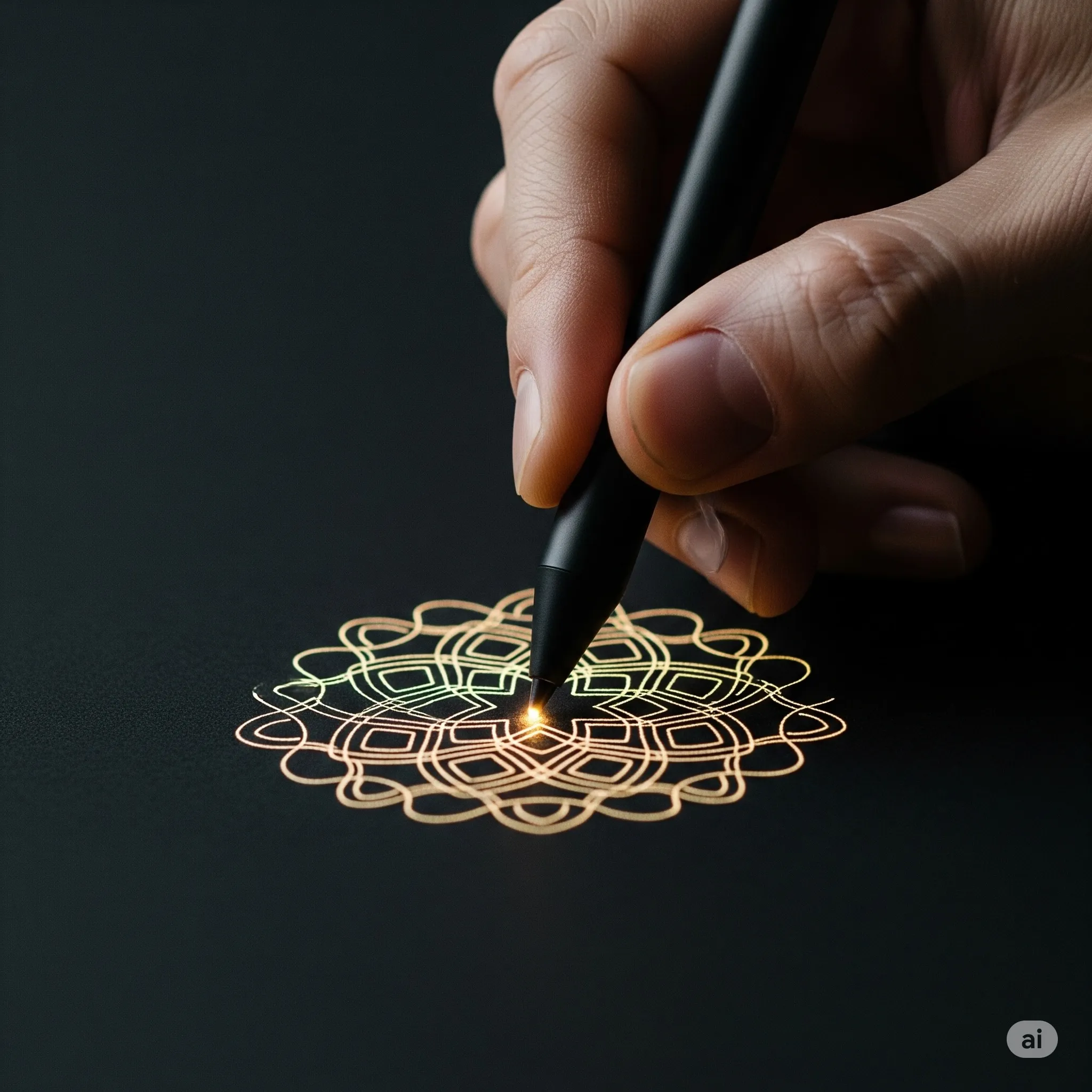
Tracing meditation disrupts this comfortable pattern by shifting your meditative anchor from an internal sensation to an external action—specifically, the physical motion of your stylus or finger as it follows a line. This isn't simply a change of technique; it's a fundamental shift in the quality of awareness required.
Consider the difference: when you follow your breath, you're observing something that happens whether you pay attention or not. Your body breathes automatically, and meditation involves tuning into this ongoing process. But when you trace, every movement is intentional, conscious, alive. The line exists only as you create it, and your attention must be fully present for the action to unfold.
This shift from passive observation to active engagement can jolt even seasoned practitioners into a more vivid state of present-moment awareness. The tip of your pen becomes an incredibly precise focal point—more concrete than the subtle sensations of breathing, more dynamic than a visualization, more immediate than a mantra. It demands the kind of granular attention that automatically generates freshness.
Research in neuroscience supports what contemplatives have long known: novel activities stimulate neuroplasticity and can break us out of habitual patterns of mind. When we engage in unfamiliar mindful activities, we're essentially cross-training our attention, developing new neural pathways that can invigorate our entire practice.

The Practice of Repetition
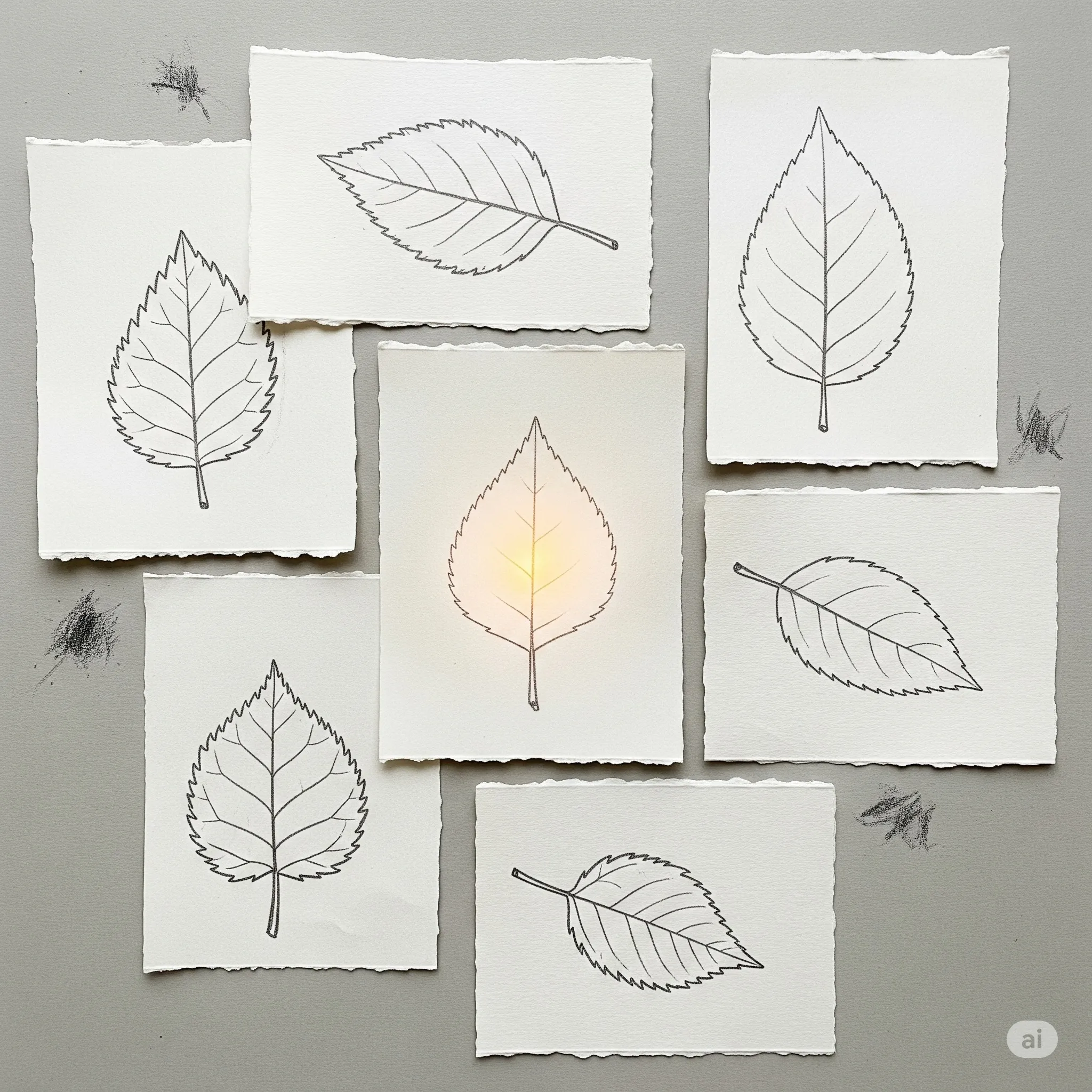
Here's where tracing meditation becomes particularly elegant for experienced practitioners: you can trace the same image dozens of times, and each encounter offers an opportunity to practice beginner's mind directly.
This might sound counterintuitive. Wouldn't repeating the same image make the practice more routine, not less? But this is where the subtle wisdom of the method reveals itself. When you trace the same mandala or nature scene repeatedly, you're not just repeating an action—you're practicing the art of encountering the familiar as if for the first time.
Each time you return to an image you've traced before, you face a choice: Will you approach it with the accumulated knowledge of previous tracings, or can you let go of that history and meet the lines fresh? This is beginner's mind in its most practical form—not as an abstract concept, but as a concrete, moment-by-moment practice.
Buddhist teacher Pema Chödrön often speaks about "letting go of the storyline," dropping our conceptual overlay to encounter raw experience. Tracing the same image repeatedly is a masterclass in this skill. Your mind will want to compare this tracing to the last one, to judge your technique, to anticipate where the lines will go. But the practice is to release these mental additions and focus purely on where your stylus is right now, in this moment, tracing this line.
This is particularly valuable for experienced meditators who may have developed subtle attachments to their practice. We know how our meditation "should" feel, what constitutes a "good" sit, what states we're trying to cultivate. Tracing the same image over and over strips away these expectations. There's no endpoint to reach, no state to achieve. There's only this line, right now, and the quality of attention you bring to it.
Letting Go of the Objective
One of the most liberating aspects of tracing meditation is that the outcome is already determined. You're not creating something new—you're following a guide. This completely removes the subtle performance anxiety that can creep into both creative endeavors and, yes, even meditation practice.
After years of sitting, experienced meditators often develop unconscious goals. We want to be more concentrated than yesterday, more equanimous than last week, more insightful than last year. These intentions aren't wrong, but they can create a subtle striving that obscures the very qualities we're trying to cultivate.
Tracing meditation sidesteps this trap entirely. Since you're following a pre-existing image, there's no question of whether you're doing it "right" or achieving the "best" result. Your line might wobble, you might miss curves, you might color outside the lines—and none of it matters. The guide holds the structure, freeing your attention to focus purely on the process.
This mirrors one of the deepest teachings in contemplative practice: the goal is not to achieve a particular state, but to fully engage with whatever is arising. When you trace, imperfection becomes not just acceptable but irrelevant. Made a mistake? Just keep going. It's just an extra line, after all. This attitude of allowing and continuing, of focusing on the journey rather than the destination, can profoundly refresh your approach to sitting meditation.
The practice teaches you to hold your experience lightly. Just as you don't need to keep the traced image after completing it, you learn to let go of each moment of meditation as it passes. This cultivates what Zen calls "no gaining idea"—the understanding that the deepest insights come not from grasping for experiences but from fully engaging with what's actually here.
Integration and Renewal
The beauty of tracing meditation for experienced practitioners is that it doesn't replace your existing practice—it revitalizes it. After spending fifteen minutes tracing mandalas with fresh eyes, you might find that returning to breath meditation feels different. The quality of attention you developed while following lines can transfer to following the breath, bringing new life to familiar territory.
This cross-training effect is well-documented in sports and music, where practicing different but related skills can improve overall performance. The same principle applies to contemplative practice. By engaging mindfulness through a different modality—visual, kinesthetic, creative—you develop new facets of awareness that enrich your entire practice.
You might try beginning your regular sitting session with five minutes of tracing meditation, using it as a way to settle into the present moment before turning inward. Or you could use tracing as a reset button between challenging periods, a way to return to beginners' mind when your practice feels stale. Some practitioners find that ending their sit with a few minutes of tracing helps integrate the qualities of stillness they've cultivated into purposeful action.
The key is to approach tracing meditation with the same quality of attention you bring to your primary practice, while remaining open to what this new form might teach you. Like any authentic contemplative method, tracing meditation is not just a technique but a gateway—a way of encountering this moment with the freshness and wonder that mark the beginning of wisdom.
After all, in the beginner's mind there are many possibilities, and perhaps the greatest possibility is discovering that beginner's mind was never something you lost—only something that was waiting to be uncovered again, one traced line at a time.